
If you are involved in agricultural practices or rural infrastructure management, you will understand that irrigation involves much more than water. The availability of reliable power is key. Farmers in rural India still rely on unreliable electricity grids or costly diesel-powered pumps for irrigating their fields.
It is here that solar water pumping systems are set to bring about a revolution.
It does not involve merely adopting a new technology. The goal is to address a chronic problem of reliability.
Why Traditional Pumping Systems Fall Short
Pumps that use electricity require power to be present. However, increased prices of electricity or of fuel to run generators and necessary maintenance make them problematic in the long run.
Both options result in unpredictability. Unpredictability, as mentioned, influences the amount of agricultural output.
What Solar Water Pumping Changes
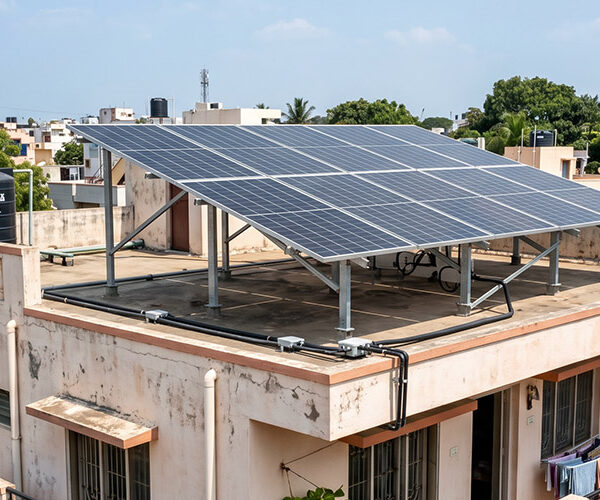
The solar water pumping system harnesses solar panels to run water pumps. Energy is generated through sunlight, eliminating reliance on electricity and fuel sources.
Irrigation will be revolutionised by the new system.
Farmers can draw water based on actual demand instead of waiting for availability of electricity. It also ensures increased safety and efficiency of labour.
Above all, the system operates at lower costs than ever before. After installation, there will be no additional fuel costs incurred.
Practical Benefits on the Ground
The benefits of using solar water pumps for agriculture can be seen in just one cycle of cultivation.
The irrigation process becomes much more reliable.
No fuel costs are incurred.
The maintenance process is much easier than with diesel pumps.
And then there is the change in behaviour. Since the power is always available through the day, farmers usually plan their irrigation rather than over-irrigating due to the restricted availability of power.
All these go hand in hand with the general concept of sustainable agriculture, which is the need of the hour.
System Design Matters More Than Installation
Solar water pumps aren’t universal.
The source of water, amount of land space, type of crops being grown, and total volume of water needed determine how the system is designed. What might be effective on one farm could prove ineffective on another farm.
That is why planning plays an essential role here.
It is crucial to ensure proper capacity of panels, pump choice, and storage facilities in accordance with actual needs. Excessive capacity will be costly; insufficient capacity will reduce efficiency.
Integration With Broader Energy Systems
Solar-powered pumps are not stand-alone solutions anymore. Rather, their adoption and implementation in the rural areas have grown to be part of a bigger system.
In one instance, any surplus power generated by the system can be used in other agricultural applications. In another scenario, such systems are connected to the electricity grid.
You can easily observe the same trend in the development of smart energy and infrastructure systems.
Innovel’s Approach on the Ground
The pragmatic approach is apparent in our experience with energy systems and solar power installations. The systems are not looked at as simply another mode of deployment. Being the best solar installation company, Innovel does its best in terms of how the systems must be looked at and how they perform in real-life situations.
Issues such as the quality of the soil and the depths of the water contribute to the discussion. This is especially important in rural areas where consistency wins trust.
Where This Is Heading
India’s agricultural sector is slowly making its way towards more dependable and sustainable sources of energy.
With the rise in solar use, solar water pumping systems have become the go-to solution for many farmers, especially in places where power supply from the grid is erratic. On the field, there is an immediate effect being seen. Farmers are taking charge of irrigation. Cost factors are coming under control. The reliance on diesel fuel is slowly diminishing.
FAQs
- What is a Solar Water Pumping System?
Ans: A system which generates electricity using solar panels and then uses the electricity to pump water for irrigation purposes.
- Is a Solar Water Pump for Agriculture Economical?
Ans: Yes, solar water pumps save on the fuel costs as well as on low maintenance costs.
- Can a solar water pumping system function without using batteries?
Ans: Solar-powered water pumps don’t need batteries to work, as most of the operations are done during the day, but battery systems are available.
- How long can a solar water pumping system serve me?
Ans: Solar panels last between 20 and 25 years, while water pumps may need maintenance from time to time.
- Which solar system installation company should I select?
Ans: Choose companies that assess water requirements, farmland condition, and usage before suggesting a suitable system.