
The roof of an industrial company hardly makes it into the financial plans of the business owners.
It shields the structure from harsh weather conditions, accommodates various equipment, and generally serves no further purpose besides. However, in the case of numerous industrial facilities, warehouses, and complexes, the roof has a significant potential to become one of the most important properties within their portfolio.
There have been significant shifts regarding solar power over recent years. Before, companies implemented solar initiatives to promote sustainable practices. Now, there is a rising trend of discussing the issue in terms of saving costs, maintaining competitiveness, and creating value.
Innovel has noticed that more and more industrial strategy makers start viewing solar initiatives through business lenses.
Electricity Is Becoming a Larger Business Risk
The cost of labour, maintenance, and production can be estimated relatively accurately in most companies.
But energy consumption isn’t like that.
Electricity costs keep increasing, fuel prices are unstable, and global shortages may have an impact on local energy economics without much notice.
Recently, events in international energy markets have proven one crucial point. A company depending solely on outside electricity will have very little influence on its biggest periodic expenditure.
And in industries that operate 24 hours a day, this poses serious challenges to profitability.
It’s no wonder then that energy policy is fast becoming a priority for industry strategists.
Looking at Solar Through a Financial Lens
However, many firms still measure the feasibility of their solar projects on the basis of installation costs alone.
Instead, it will be more beneficial to look at how much money a firm spends on electricity and how much money it will be spending in the upcoming ten years.
Take the example of a business with a power demand averaging around 2 MW.
With electricity tariff rates between ₹8 and ₹10 per unit, electricity expenses might easily cross ₹14 crore to ₹18 crore every year.
Compare this with another business which manages to reduce its usage significantly through on-site solar power.
In most cases, the cost of electricity would reduce to around ₹5 crore to ₹7 crore.
This translates into a saving of ₹7 crore to ₹11 crore every year.
Crucially, this saving doesn’t just happen once; it happens every single year.
The 10-Year Value Creation Opportunity
When evaluating machinery, companies look at productivity improvements over the entire life span of the machinery.
Solar power should be no different.
Assuming savings are between ₹7 crore and ₹11 crore per year, the total impact after ten years would be between ₹70 crore and ₹110 crore.
This calculation ignores the possibility of increased tariffs in the future.
The higher the price of electricity, the more value there is in the production of that electricity.
That is when the discussion changes at Innovel. Solar becomes a source of revenue rather than an expense.
Why CFOs Are Paying Attention
Conventional electricity bills are periodic costs. Year after year, businesses continue to make these payments and, more often than not, pay higher.
An investment in solar power turns part of future electricity costs into lasting investments. Businesses are no longer totally reliant on tariff variations; they now have better insight into costs.
A business could be able to establish assets worth more than ₹100 crore through investing around ₹15 crore in solar power systems during their lifespan.
It is an entirely different ball game compared to just talking about energy savings.
Solar Plus Storage Is Strengthening Energy Independence
Reduction in cost is only part of the picture.
Reliability is essential to industrial operations today.
Interruption in power supply, uncertainty, and market instability all have an impact on scheduling for manufacturers.
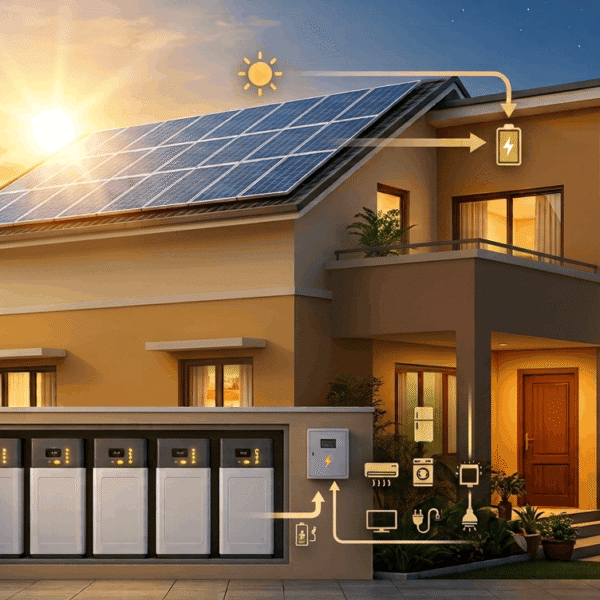
This is precisely why solar energy systems alongside battery storage are being assessed by many organisations.
The pairing of both solar energy and battery storage allows organisations greater flexibility, as well as support during times of uncertainty.
At Innovel, it’s our observation that this will be an important part of energy independence plans moving forward.
The Cost of Waiting Is Often Overlooked
Many organisations take months in analysing renewable energy projects while paying for increasing power costs.
For organisations having power requirements more than 1 MW, even a one-year delay results in the loss of savings worth crores.
Such costs are never incorporated in the calculation of the project cost but definitely affect profits.
In most instances, the cost of delay outweighs the cost of investment.
Where Innovel Fits Into the Picture
Innovel assists companies in conducting their analysis of the use of solar energy not only operationally but also from a business perspective.
Each installation site has different characteristics such as, usage, facilities, etc. A good solar approach starts by assessing these parameters and designing an approach based on that assessment.
The best solar approaches aren’t determined purely by technology; they are determined by business results.
FAQs
How much savings can be made on electricity prices with industrial solar?
It depends on how energy is consumed, the size of the system, and the prices paid, but many companies experience substantial savings from their annual electricity bills.
Is solar an appropriate choice for industrial applications?
Solar could lead to cost savings, energy security, and financial certainty for energy-intensive industries.
What does energy independence mean in industry?
Energy independence means that an organisation would become less dependent on electricity produced externally by employing various energy independence measures.